Undefined baseline
No one knows which requirement was actually accepted.
Accepted scope · sprint by sprint
Alignia turns requirements, staging and acceptance into a versioned history. When the agreement changes, the team sees the delta and negotiates the change request before coding.
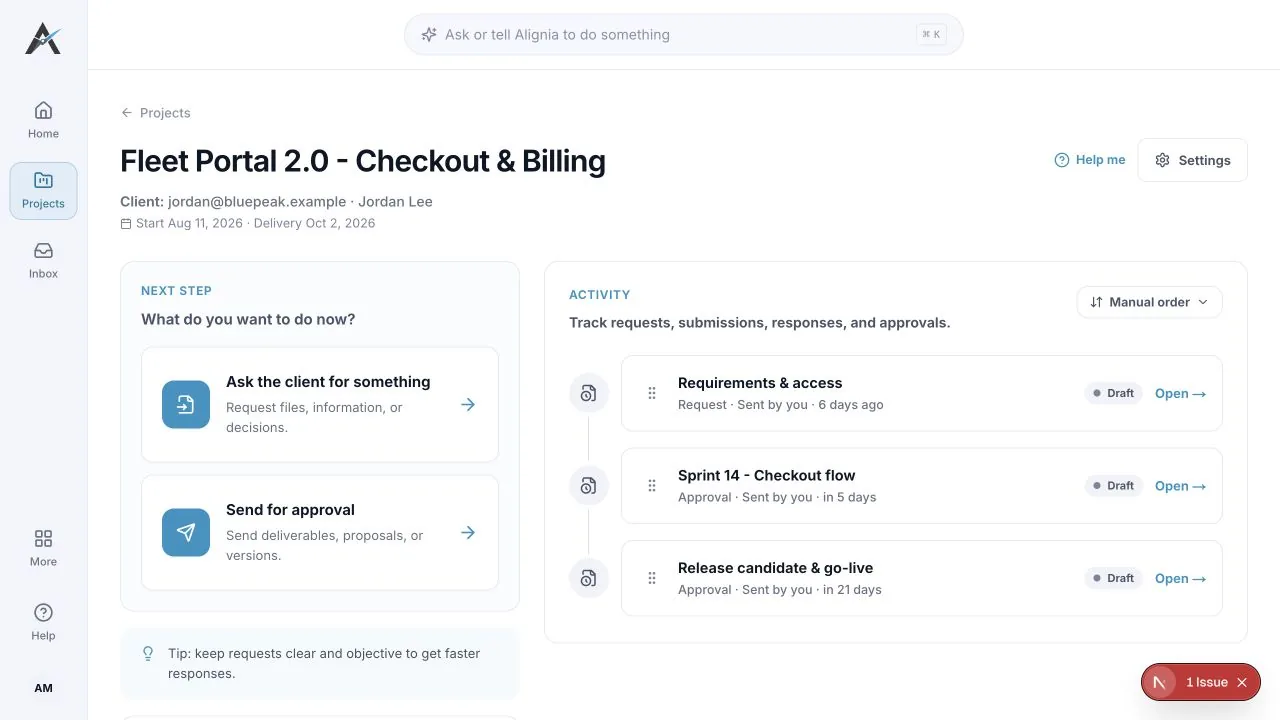
Fleet Portal 2.0 · English
For software houses, consultancies and developers
Versioned requirements
Traceable UAT
Clearer change requests
scope_creep.detected()
A ticket is not client acceptance. Chat is not a scope baseline. Without a clear decision, the team builds, the client disputes and margin pays the difference.
No one knows which requirement was actually accepted.
Engineering hours return to a story that was already done.
The delivery exists, but acceptance is scattered across comments and calls.
approval.pipeline()
Alignia does not replace Jira, Linear or GitHub. It closes the decision with people outside your team.
Present the requirement, acceptance criteria, API contract or prototype in the client’s language.
Group staging links, evidence and test cases in one focused review.
Link the decision to the version before merge, release or the next sprint.
client_boundary
Alignia solves the boundary between builders and decision-makers — where scope confusion usually starts.
cost_of_rework()
Estimate the monthly cost of repeated discovery, rebuilt implementation and UAT without a baseline.
A recorded decision helps turn a new request into new backlog — with its own timeline and budget.
Acceptance without ambiguity
When the developer sends it and I approve, there is no doubt about what will be delivered. Everything stays recorded and available for reference.
Rogério CorrêaClient, PitchYn
production_ready
Each client and participant only accesses their part of the workflow.
Person, date, time, IP and presented content stay associated.
Use it to summarize and translate — or disable it for sensitive projects.
Frequently asked questions
No. Your team keeps its current stack. Alignia organizes reviews and acceptance with external clients and stakeholders.
Yes. Combine links, acceptance criteria, text and documents in one round.
Yes. The interface and portal support Portuguese, English and Spanish, selected per project.
Yes. Checkpoint history can be exported for project documentation and closure.
Start now
Your first project is free. Put the next UAT round into a traceable flow.